There is a political formula that has worked for centuries.
Tell the majority they are in danger.
Position yourself as their only protector.
And then, never let that danger go away.
Because the moment people feel safe, they start asking questions. And questions are where power starts to loosen.
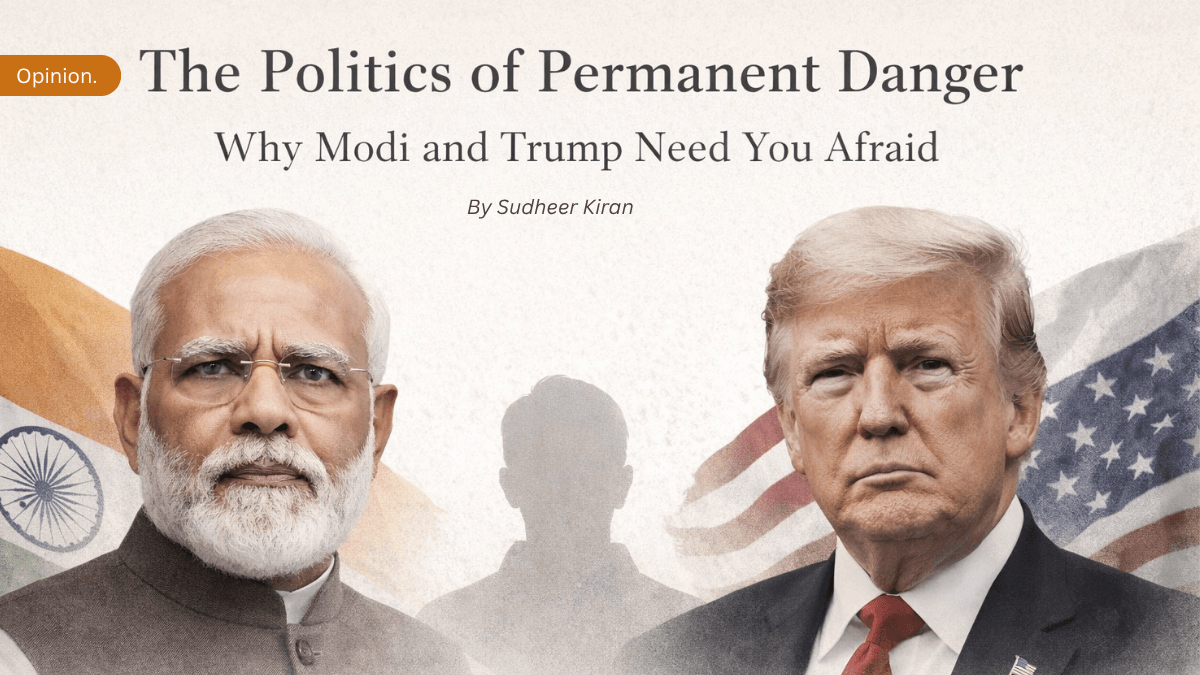
This is not unique to one country or one leader. But two of the most visible examples of this model running in real time are Narendra Modi and Donald Trump. Different countries, different languages, very different histories. But the same playbook, page for page.
The Script Is Identical
Both leaders built their political identity on a single founding claim: everything before me was failure.
Your country was broken.
Your past leaders were weak, corrupt, or incompetent.
The nation was heading toward danger.
And then I arrived.
This narrative is effective not because it is accurate. It is effective because it rewrites memory. It takes decades of complex governance, institution-building, and real progress, and compresses it into a single emotion: betrayal.
Once people accept that frame, they stop asking what was built. They start asking only who can save them.
What Actually Built These Countries
Let me be direct here, because this part gets conveniently skipped in the PR version.
India did not become a rising global power because of any single leader’s charisma.
India’s credibility, its institutions, and its global relevance were built across decades.
Jawaharlal Nehru, whatever your political position on him, oversaw the construction of the IITs, IIMs, IISc, ISRO, DRDO, and the foundational policies that created a knowledge-driven economy. These were not symbolic gestures. They created real capability, exported talent globally, and gave India scientific and strategic weight that no one gave it for free.
And it did not stop with Jawaharlal Nehru.
Every decade added another layer to India’s capability.
Indira Gandhi centralized political power in controversial ways, yes. But she also made decisive moves that reshaped India’s strategic posture. The 1971 war and the creation of Bangladesh established India as a regional force that could act, not just react. The Green Revolution scaled under her leadership turned food scarcity into self-sufficiency. That matters more than slogans.
Rajiv Gandhi pushed India into the technological age before it was fashionable. His focus on computers, telecom, and education reforms laid early groundwork for what would later become India’s IT dominance. At the time, he was mocked for it. Today, that bet defines India’s global economic identity.
P. V. Narasimha Rao, alongside Manmohan Singh, did something far more difficult than making speeches. They changed the direction of the economy. The 1991 liberalization reforms pulled India back from the edge of collapse and unlocked decades of growth. That single shift created the middle class that politicians now campaign to.
Atal Bihari Vajpayee combined political stability with long-term infrastructure thinking. The Golden Quadrilateral was not just a highway project. It was an economic multiplier. Connectivity is not glamorous. But it is what actually drives trade, logistics, and national integration.
Manmohan Singh, in his tenure as Prime Minister, carried that economic momentum forward. High growth years, global integration, expansion of services, and a relatively stable macroeconomic environment. You can debate policy choices. But you cannot deny the trajectory.
Narendra Modi gets standing ovations on foreign trips. But that respect is borrowed from the India his predecessors built. The market size, the geopolitical importance, the institutional credibility. None of that came from his government. He just brought a better camera crew and a more aggressive PR operation.
America’s story is the same.
The idea of the American Dream was not a campaign slogan. It was a policy outcome. Built over generations through immigration-driven innovation, institutional continuity, investment in research, and a network of global alliances that gave the United States genuine leadership, not just leverage.
Trump’s claim that America had “lost its way” before him was the first lie people were fed, and many are still carrying it. America was the most powerful country on earth when he took office in 2017. The question of what specific thing he built to make it greater remains genuinely unanswered.
Name One Thing They Built
This is the question that makes supporters uncomfortable. Not because they’re bad people. But because they do not have an answer.
Narendra Modi: Name one institution built under his government that will outlast the next decade.
Not a renamed one. Not a rebranded scheme. An original institution, policy, or structural reform that created compounding national capability the way IIT or ISRO did.
Donald Trump: Name one policy from either term that created lasting structural advantage for average American citizens.
Not a tax cut that predominantly benefited corporations and the wealthiest households. Not a tariff war that raised consumer prices. A durable, measurable improvement in the lives of the working-class voters who supported him.
I’m genuinely asking. Because I cannot find a clear answer. And neither can most supporters when pushed past the slogans.
The Friends Question
Here is a simpler test.
Before Modi, India had a carefully managed position across global relationships. Not perfect. But functional, strategic, and respected. Can you name one strong, reliable ally India has built or deepened under his tenure? One relationship where another country sees India as a trusted long-term partner and acts accordingly?
Before Trump‘s first term, the United States led coalitions. NATO was functional. The G7 was coherent. Multilateral agreements, for all their flaws, gave America diplomatic leverage.
Today, where does that stand? “America First” turned out, in practice, to mean “America negotiating its credibility back from scratch.”
These are not rhetorical questions. They are the actual measure of whether a foreign policy is working.
What Happened to the Media
Both leaders understood early that narrative control is power.
The approach is not always loud or obvious. It is a gradual process. Critical outlets lose access. Friendly outlets get amplified. Journalists who ask uncomfortable questions get labeled enemies of the nation, of the people, of truth itself.
In India, independent media has been systematically pressured. Ownership changes hands. Outlets that maintained editorial independence have either softened or been edged out of relevance. What remains in prime time is largely a performance, not journalism.
In the United States, Trump did not hide his contempt for independent press. “Enemy of the people” was not a slip. It was a policy signal to his base. And now, with his return, the pressure on media institutions and the judiciary is more direct, not less.
When media gets bought, threatened into compliance, or drowned out by state-friendly noise, the average person is not getting information. They are getting a managed version of reality.
Which brings us to the supporters.
Let’s Talk to a Supporter
Go find a strong Modi supporter. Or a strong Trump supporter. Sit down and have a real conversation.
You will notice something consistent: deep conviction, strong emotional connection, and almost no verifiable data backing any specific claim.
The arguments sound like:
- “He is strong.”
- “He speaks for us.”
- “Things are better now.”
- “The country is finally respected.”
Push further. Ask for specifics.
- Which policy?
- Compared to what baseline?
- What data are you using?
The answers blur. The conversation moves back to feelings, to identity, to “you just don’t understand.”
This is not accidental. It is the intended outcome of the model. Support built on identity does not require evidence. It only requires belonging.
Ricky Gervais said it plainly: “Think of how stupid the average person is, and realize half of them are stupider than that.”
I’m not saying this to mock anyone. But I am saying that when the average person is getting all their information from media that was purchased or pressured into a specific narrative, and never encounters a genuine contradiction, what they believe is not really their own conclusion. It was installed.
When I see someone fully in that mode, who cannot give you a single clear, data-backed answer, who responds to questions with hero-worship and deflection, I don’t see a patriot. I see someone who has been colonized by a narrative. Not by a foreign power. By their own government’s communication machine.
When Identity Replaces Thinking
This is where something deeper happens. Something more psychological than political.
There’s a line of thought from George Carlin that has always stayed with me. Not his exact words, but the way I’ve come to understand it is this:
I tend to like people more as individuals. You can talk to them, understand them, see their nuance. But when they become part of a group, an identity, something changes. It feels like they give up a part of that individuality. They trade independent thinking for belonging. And somewhere in that shift, they become easier to influence, easier to simplify.
That’s how it feels to me when I have these conversations.
Individually, people are capable of nuance. They can question. They can hold contradictions. They can admit uncertainty.
But once identity takes over, something changes.
- Questioning feels like betrayal
- Doubt feels like weakness
- Loyalty replaces logic
And suddenly, intelligence is no longer measured by how well you think, but by how strongly you agree.
This is why conversations break down so quickly. You are not arguing with a person anymore. You are arguing with an identity they feel obligated to defend.
And identities don’t debate. They react.
They Don’t Like Questions. That Tells You Everything.
A simple way to evaluate any leader: watch how they handle an unscripted question.
Narendra Modi famously does not hold press conferences. His interviews are pre-arranged, question lists reportedly shared in advance, and the format is largely designed to display rather than interrogate. When a journalist once asked him about the widening gap between rich and poor in India, his response was reportedly: “Should everyone become poor?”
That answer, from a sitting Prime Minister of a country with hundreds of millions living in poverty, is not just a bad answer. It reveals the absence of serious engagement with the question entirely.
Donald Trump‘s relationship with honest questioning is well-documented. Word-salad answers to direct policy questions. Attacks on the questioner’s credibility instead of engaging the substance. A visible preference for rallies, where the crowd is pre-selected and the energy is controlled, over formats where he might be held to account.
When a leader consistently avoids real questions, it is not because they are too busy. It is because the answers do not exist, or the answers would not survive the scrutiny.
The Cost Is Not Immediate
This is what makes fear-driven governance so effective in the short term and so destructive over time.
The damage is slow. Institutions weaken by degrees. Public discourse becomes more polarized. Citizens become more reactive and less analytical. Global relationships fray quietly before they break loudly.
And by the time the full cost is visible, the leader has moved on. They are either out of power or pointing at the next enemy.
India and the United States were not built by strongmen with great PR. They were built by institutions, by informed citizens, by continuous questioning of leadership, and by the willingness to hold power accountable even when it was uncomfortable.
When any leader, regardless of the country, asks for belief without evidence, loyalty without accountability, and support without scrutiny, they are not making the nation stronger.
They are making themselves harder to remove.
That is not leadership. It is self-preservation dressed as patriotism.
What did I miss? Tell me in the comments. I’d rather have this argument out loud than let it stay in the margins.