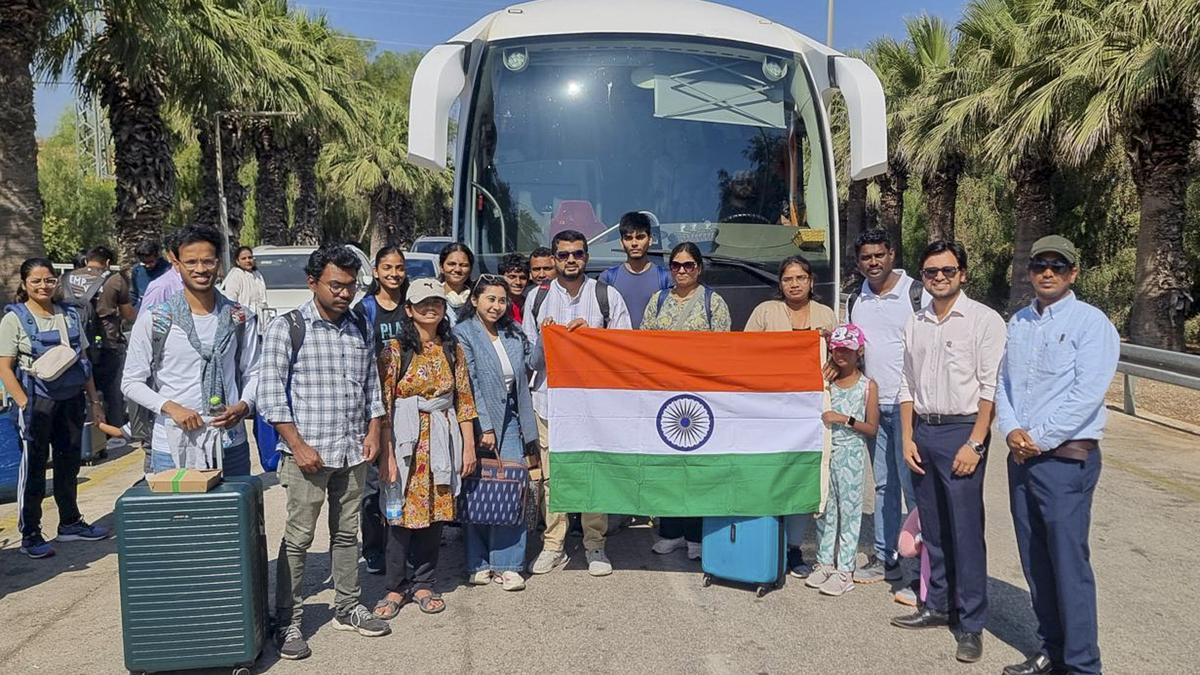
In a carefully planned and swift operation, 443 Indian nationals were evacuated from war-hit Israel on Monday, June 23, as part of a coordinated mission involving India, Jordan, and Egypt. With this, the total number of evacuees has risen to 603 within just two days.
The evacuation, carried out under Operation Sindhu, involved two separate groups crossing the Israeli borders — 175 headed towards Jordan and 268 towards Egypt. From there, both groups were flown back to India on special flights arranged by the Ministry of External Affairs (MEA) in collaboration with Indian embassies in the respective countries.
This comes a day after the first group of 160 Indians crossed into Jordan on Sunday, June 22, and were airlifted by Monday afternoon. These back-to-back evacuations have provided much-needed relief to Indians who have been living under constant threat in Israel, often rushing to bunkers and fortified shelters amid sirens warning of missile attacks.
To streamline the mission, the Indian Embassy in Tel Aviv activated a 24×7 Control Room last week. It handled registrations through an online portal, managed thousands of calls and emails, and created a comprehensive database of Indian citizens across the country. Evacuation was prioritized based on urgency, with medical cases, children, women, and students being given first preference.
According to officials, the mission was being closely monitored by Prime Minister Narendra Modi himself, who was receiving real-time updates. The embassy staff personally contacted those registered to confirm travel arrangements and assign them to specific flights.
The current crisis has seen direct attacks on civilian areas across Israel, including cities like Haifa, Ramat Gan, Beersheba, and even research institutions like the Weizmann Institute of Science in Rehovot. For many Indians living in northern and southern Israel, safe rooms have become temporary refuges from frequent missile and drone strikes reportedly launched from Iran.
Indian officials credited the governments of Israel, Jordan, and Egypt for extending full cooperation in facilitating smooth border crossings and onward transit. Indian embassies in Amman and Cairo played key roles in receiving evacuees and assisting with travel logistics.
Operation Sindhu is now part of India’s growing list of emergency evacuations — following previous efforts like Operation Ganga (Ukraine), Devi Shakti (Afghanistan), Kaveri (Sudan), and Ajay (Israel, in a prior conflict phase). These missions highlight India’s proactive approach in protecting its diaspora during international crises.
A fresh advisory from the Indian embassy in Tel Aviv urged all Indian nationals who haven’t yet registered to do so immediately. With more than 40,000 Indians currently residing in Israel — including caregivers, students, construction workers, and professionals — authorities remain on high alert and ready to respond as the situation evolves.
India’s swift response underscores its increasing global presence and its strong commitment to citizen welfare, no matter where the crisis unfolds.