
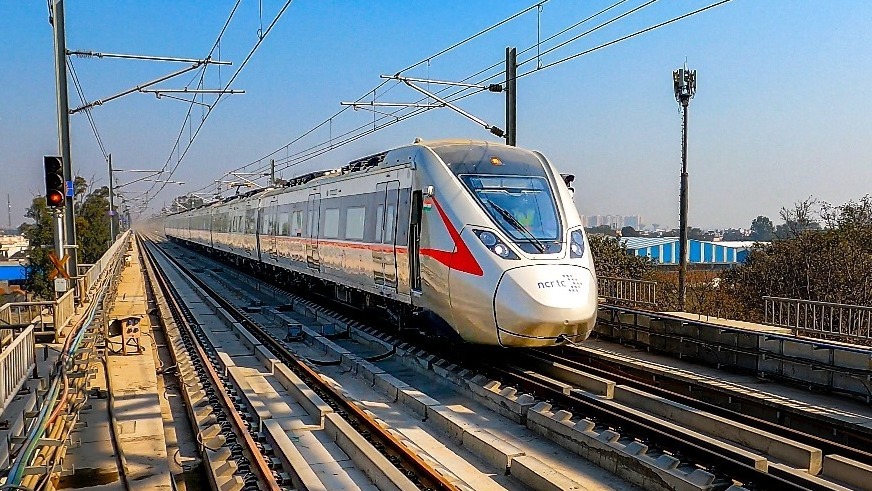
New Delhi: The Delhi–Meerut Namo Bharat corridor has now become fully operational, bringing high-speed regional rail connectivity to the heart of the National Capital Region. Prime Minister Narendra Modi inaugurated the complete stretch along with the Meerut Metro, formally opening what is being described as India’s fastest urban transit system.
Developed by the National Capital Region Transport Corporation (NCRTC), the 82-kilometre Delhi–Ghaziabad–Meerut Rapid Rail Transit System (RRTS) is expected to transform daily commuting between the national capital and western Uttar Pradesh. With modern coaches, integrated ticketing and frequent departures, the corridor is designed to offer a reliable alternative to congested highways.
The Namo Bharat service originates from Sarai Kale Khan in Delhi and moves through key urban centres such as New Ashok Nagar, Anand Vihar and Sahibabad before entering Ghaziabad. From there, the trains continue across Guldhar, Duhai, Muradnagar and Modinagar, eventually reaching Meerut. Within Meerut city, the network connects important localities including Meerut South, Shatabdi Nagar, Begumpul and Meerut Central before terminating at Modipuram. The Meerut section features a mix of elevated and underground stretches to navigate dense residential zones.
One of the biggest advantages for commuters is the sharp reduction in travel time. The full journey between Sarai Kale Khan and Modipuram is expected to take under an hour — roughly 55 to 58 minutes — a significant improvement compared to road travel during peak traffic hours. The Meerut Metro, which operates along the city stretch, further strengthens last-mile connectivity within the urban area.
Authorities have adopted a distance-based fare structure aimed at keeping the service accessible to daily travellers. Ticket prices begin at around ₹20 and can go up to approximately ₹150 depending on the distance covered. A single integrated ticket allows passengers to move seamlessly between the Namo Bharat trains and the Meerut Metro, reducing the need for multiple bookings.
Train frequency has been planned with office commuters in mind. Namo Bharat services are scheduled at intervals of about 10 minutes, while the Meerut Metro runs even more frequently along the shared city section. Operations generally begin early in the morning and continue till late evening, ensuring flexibility for both work and leisure travel.
The inauguration event also signalled a larger expansion plan for the NCR’s rapid rail network. Union Housing and Urban Affairs Minister Manohar Lal Khattar indicated that two additional rapid rail corridors starting from Sarai Kale Khan are expected to move forward soon. One proposed route aims to connect Delhi with Karnal in Haryana, potentially covering over 125 kilometres in about one-and-a-half hours. Another corridor has been proposed toward Babarpur in Haryana and Neemrana in Rajasthan, further widening the high-speed transit grid around the capital.
Officials say Sarai Kale Khan is being developed as a major interchange hub that will anchor future rapid rail expansion. The broader objective is to ease pressure on Delhi’s roads by distributing economic activity and population growth across neighbouring districts in Haryana, Uttar Pradesh and Rajasthan.
With the full commissioning of the Delhi–Meerut Namo Bharat corridor and the launch of the Meerut Metro, regional mobility in north India has entered a new phase. Faster journeys, predictable schedules and modern infrastructure are expected to make rail the preferred choice for thousands of daily commuters across the NCR.
Sources:
National Capital Region Transport Corporation (NCRTC)
Inauguration address and Union Housing and Urban Affairs Ministry statements