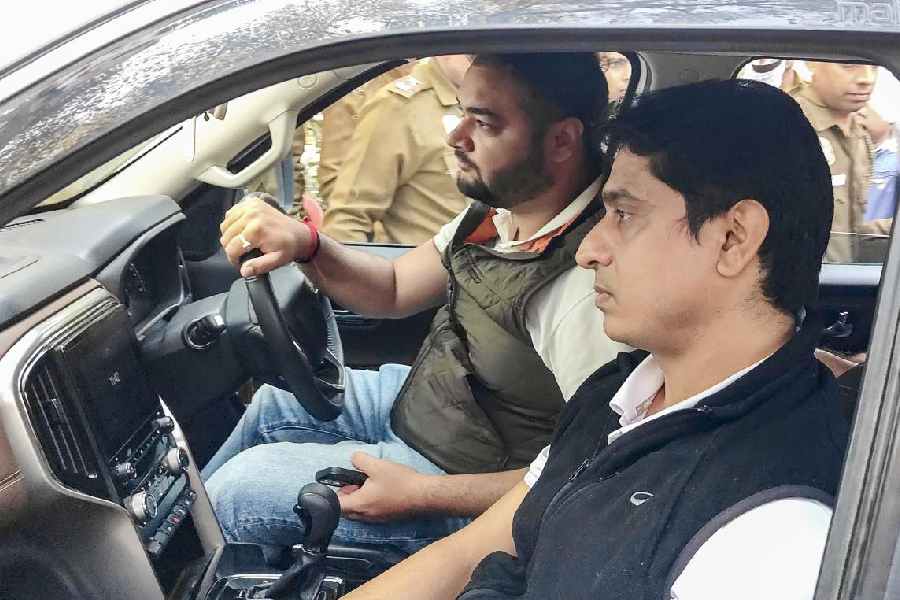
In a significant legal development following last week’s India AI Impact Summit, a Delhi court on Tuesday placed Indian Youth Congress (IYC) President Uday Bhanu Chib into four-day police custody. The order, delivered by Judicial Magistrate Ravi, follows an investigation into a coordinated protest that took place within the high-security premises of Bharat Mandapam in the national capital.
The incident occurred during a high-profile international summit where several IYC members managed to gain entry to the venue. Once inside, the protesters removed their shirts to reveal T-shirts printed with slogans directed at the Central government’s trade policies and the India-US interim trade arrangement. While security personnel intervened quickly to escort the group out of the hall, the fallout has led to a series of arrests across multiple states.
With Chib’s detention on Tuesday, the total number of arrests in the case has risen to eight. Among those already taken into custody are three workers from Gwalior, Madhya Pradesh, and a general secretary from the Uttar Pradesh wing of the IYC. Investigators are currently examining how the group obtained access to the event, noting that the individuals had registered online to receive QR codes that allowed them to pass through security checkpoints.
During the court proceedings, the prosecution presented a case centered on the alleged coordination behind the demonstration. Although Chib was not physically present at Bharat Mandapam during the protest, the public prosecutor argued that he was the primary figure monitoring the situation and directing the participants. The state contended that such an action at an international event had the potential to disturb public order and that, as a national leader, Chib carried an added level of responsibility for the conduct of his organization.
In response, the defense team argued against the necessity of police remand. Counsel for the IYC president maintained that the protest was a non-violent form of political criticism and did not result in any riot-like situation. The defense further argued that since the participants were unarmed and no physical material remained to be recovered, custodial interrogation was unnecessary. They characterized the event as a peaceful demonstration intended to raise policy concerns rather than a criminal conspiracy.
However, the legal situation has grown more complex as police invoked additional sections under the Bharatiya Nyaya Sanhita. These new charges include provisions related to promoting enmity between groups and making statements prejudicial to national integration, which can carry a maximum sentence of three years in prison. These are in addition to initial charges involving criminal conspiracy, unlawful assembly, and the obstruction of public servants.
As the investigation enters this new phase, authorities are scrutinizing the financial aspects of the protest, including the printing of the slogan-bearing T-shirts and the timeline of the planning phase. While political reactions remain polarised, with critics calling the protest an inappropriate disruption of a global summit and supporters defending it as a legitimate exercise of dissent, the court’s decision ensures that the interrogation of the IYC leadership will continue through the week.